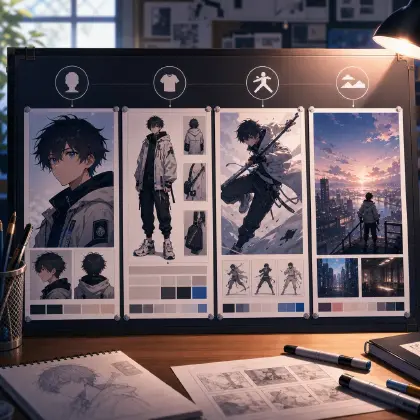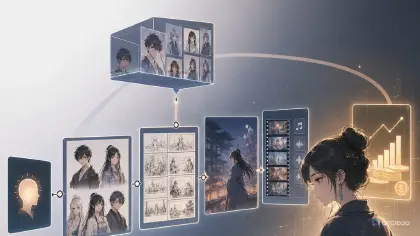
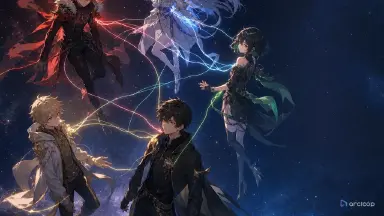
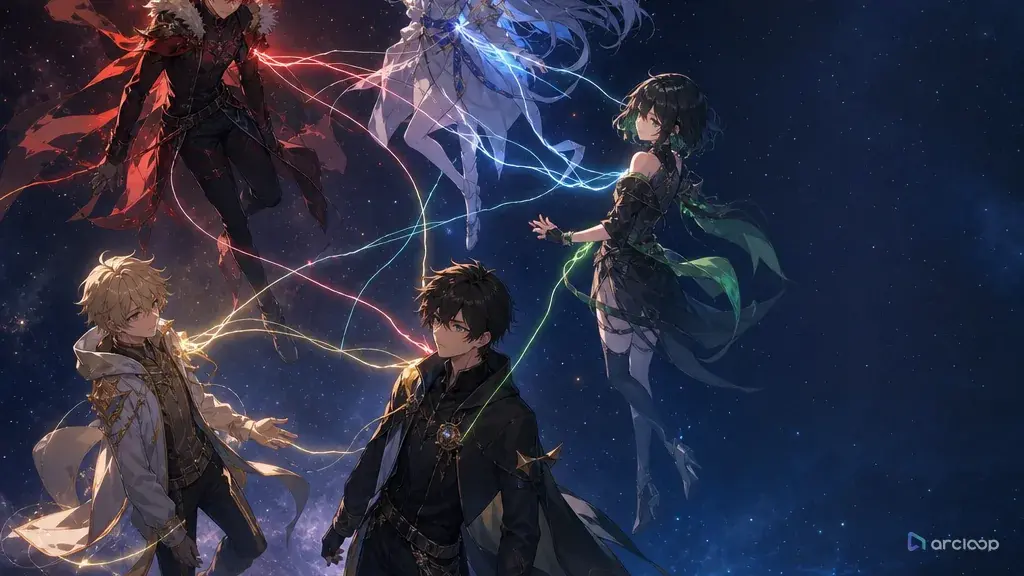
Introduction: When a Relationship Chart Becomes a Messy Poster
You try to make a character relationship chart for an anime short. The generated image has nice portraits, dramatic arrows, colored lines, and a background that looks expensive. Then you zoom in and realize the chart cannot be used. The labels are unreadable, the arrows cross everywhere, two characters look swapped, and none of the lines tell you what actually happens in a scene.
A useful relationship chart is not a decorative cast poster. It is a story tool. It should help you decide who pressures whom, who knows the secret, who blocks the lead, who is loyal in public but doubtful in private, and which relationship changes first. For AI anime production, the chart also has a second job: keeping character identity and scene dynamics stable across prompts.
This guide explains how to prompt character relationship charts that are readable, reusable, and connected to production in ArcLoop. It covers cast portraits, relationship lines, tension labels, faction grouping, layout rules, and how to turn a chart into storyboard and shot prompts. If portraits are not stable yet, start from the character asset fields breakdown. Then keep the working chart in ArcLoop Worlds alongside the rest of the project.
Core Principles for Character Relationship Charts
The first principle is readability before decoration. If arrows, names, or factions cannot be understood at a glance, the chart has failed. A clean chart with plain spacing beats a beautiful poster that nobody can use.
The second principle is relationship verbs. "Friend," "rival," and "mentor" are too broad by themselves. Use verbs or pressures: protects, blackmails, trains, envies, suspects, covers for, owes, fears, tests, recruits, or betrays.
The third principle is stable portraits. Each cast portrait should reuse the approved character anchors from the sheet: hair shape, costume color, prop, expression, and silhouette. Relationship planning should not accidentally redesign the cast.
The fourth principle is line hierarchy. Not every relationship deserves the same visual weight. Main conflict lines should be bold or central. Background alliances can be thinner, grouped, or omitted from the first version.
The fifth principle is faction grouping. Place characters by team, family, school club, guild, enemy cell, household, or production unit when that helps the story. Spatial grouping reduces crossing lines.
The sixth principle is version control by story beat. A chart before episode one and a chart after the betrayal are different assets. Do not force the whole season into one static image if the relationships change.
Step-by-Step Relationship Chart Prompt Structure
Start with the chart purpose. Is it for writing, character design, a story bible, a social teaser, or internal shot planning? A public teaser can hide spoilers; a production chart should show the working truth.
List the cast with anchors. For each character, write name, role, visual anchor, and one relationship pressure. Keep this compact — it's the material you'll turn into character assets and portrait shots next.
Define the relationship types. Choose a small legend: trust, conflict, secret, dependency, rivalry, family, command, debt, or romance. Avoid too many line types in the first pass.
Choose layout logic. Put the protagonist in the center only if the story revolves around them. For faction stories, use clusters. For mystery stories, put the secret holder off-center. For ensemble comedy, use groups by daily location.
Write line labels as short phrases. "Owes a rescue," "hides the map," "tests loyalty," or "protects in public" gives more production value than a long paragraph.
Add visual constraints. Request clean spacing, readable portraits, consistent face and outfit anchors, no fake tiny text, no tangled arrows, no random extra cast, and no unreadable labels. If text rendering is unreliable, ask for blank label zones and write the exact relationship wording into the shot description instead, where it will actually be read.
Turn the chart into shots. After the chart works, use it to decide which characters belong in each scene. If a relationship line is important, it should become blocking, dialogue direction, gaze, distance, or a prop handoff in a later shot prompt.
Keep the Relationship Chart Beside the Assets It Describes
A relationship chart works best kept beside the character assets, scene beats, storyboard panels, and shot prompts it feeds — not planned in isolation. Keep it as a live reference in ArcLoop Worlds next to the rest of the project.
Build the chart in layers. First, create or attach character sheets from Character Sheet Templates. Second, write a short note on what each character does in the story. Third, generate a relationship chart board with clean layout and review criteria. Fourth, write scene prompts from the chart: who stands close, who avoids eye contact, who holds the shared object, and who blocks the exit.
When reviewing drafts, separate two questions. Did the chart preserve character identity? Did the chart explain story pressure? A take can have correct faces but useless lines, or clear lines with redesigned characters. Repair the failed layer only. For cast role logic, pair this with Character Cast Planning and Supporting Character Function Guide.
Example Prompt 1: Relationship Chart for a Lighthouse Academy Mystery
Create a clean relationship chart for an original 2D anime mystery short called "Lighthouse Academy After Curfew." Purpose: internal story planning, not a public spoiler poster. Use five portrait nodes with blank label zones and readable relationship lines.

Cast anchors: Rell, protagonist, tan skin, short blue hair, cream academy cape, cracked compass pin; Minae, rule keeper, long black ponytail, red glasses, navy armband, key ring; Corvin, prank broadcaster, silver curls, orange hoodie under uniform jacket, pocket radio; Yutri, scholarship diver, dark green braid, patched boots, brass air-tank charm; Head Aster, quiet astronomy teacher, gray bob, white gloves, star chart folder.

Relationship lines: Rell owes Minae a public apology but hides why; Minae suspects Corvin of broadcasting the curfew signal; Corvin protects Yutri's secret diving route; Yutri found Rell's compass near the locked lighthouse; Head Aster knows the old signal schedule and tests all four students. Layout: Rell center-left, Minae near the gate side, Corvin and Yutri as a lower pair, Head Aster above them but not heroic. Use simple colored lines for trust, suspicion, secret, and debt. Keep portraits consistent, spacing clean, no tangled arrows, no random sixth character, no fake tiny text, no photorealism.
This prompt makes the chart useful for writing. The relationship lines are scene material, not vague status labels.
Example Prompt 2: Chart-to-Scene Blocking Prompt
Use the approved "Lighthouse Academy After Curfew" relationship chart to create a 7-second 2D anime scene in the academy's damp map room. Camera: medium-wide locked shot with the central table visible. Rell stands center-left with the cracked compass pin in hand. Minae blocks the door on screen right, key ring visible. Corvin sits on the window ledge pretending to repair his pocket radio. Yutri stands near the rolled sea maps with one patched boot hiding a wet footprint. Head Aster's star chart folder rests on the table, but Aster is not visible in this shot.

Relationship pressure to show: Rell wants answers from Yutri, Minae suspects Corvin, Corvin silently protects Yutri, and Aster's absent authority controls the room through the folder. Motion: compass needle twitches, key ring swings once, radio light flickers under Corvin's thumb, wet footprint spreads slightly. Use clean 2D anime lighting, blue-gray map room shadows, readable hands and props. No extra students, no crossed unreadable staging, no text overlays, no portrait-poster composition, no costume swaps.
The chart becomes blocking. Each relationship appears through placement, props, and gaze direction.
Example Prompt 3: Controlled Revision for a Tangled Chart
Revise the selected relationship chart for "Lighthouse Academy After Curfew." Keep the five approved portraits, visual anchors, and faction logic. Do not redesign characters and do not add new cast members.

Problem to fix: the current chart looks like a messy poster. Relationship lines cross through faces, suspicion and debt are visually equal, and the secret route between Corvin and Yutri is hard to find. Repair only chart readability.

Required changes: move Rell slightly left of center, place Minae near the door/gate side, keep Corvin and Yutri as a lower pair, place Head Aster above with a thinner authority line. Use thicker lines for the main suspicion and secret-route relationships, thinner lines for background debt. Leave clean blank zones for labels instead of tiny unreadable text. Preserve Rell's cracked compass pin, Minae's red glasses and key ring, Corvin's pocket radio, Yutri's brass air-tank charm, and Aster's star chart folder.

Reject if arrows cross faces, labels become fake text, portraits drift, or the chart adds decorative symbols that do not explain relationships.
This revision asks for one repair: chart readability. It does not throw away portraits that already worked.
Common Relationship Chart Mistakes
The biggest mistake is trying to show every relationship with equal force. Main story pressure should be easy to find. Minor friendships and background lore can live in notes or later versions.
Another mistake is using labels that do not create scenes. "Complicated" tells you nothing. "Hides the map from her" or "owes him a rescue" can become a shot.
Creators also make charts too text-heavy for generated images. If exact wording matters, keep the precise text in your own shot description and ask the image only for clean label zones or simple visual grouping.
A fourth mistake is letting chart generation redesign the cast. Use approved character sheets as references and repeat the identity anchors. A relationship chart is not the place to reinvent hair, outfit, or props.
Finally, do not treat the chart as final truth forever. Update it after major story turns. A betrayal, confession, rescue, or failed promise should create a new version.
FAQ
What should a character relationship chart include?
Include the cast portraits, visual anchors, relationship verbs, line types, layout logic, and review criteria. For production use, also note which relationships must appear in the next scene.
How many characters fit in one relationship chart?
For a readable AI-generated chart, four to seven characters is a practical range. Larger casts usually need faction charts, episode charts, or separate protagonist-centered maps.
Should relationship charts include spoilers?
Internal production charts should include the truth needed to plan scenes. Public teaser charts can hide spoilers by using softer labels or omitted secret lines.
How do I turn a relationship chart into an anime scene?
Convert each important line into blocking, gaze, distance, prop handling, or reaction. If the chart says one character suspects another, show that through position and behavior in the shot prompt.
How do I keep a relationship chart connected to the character assets it describes?
Keep the chart, the character assets it references, and the storyboard in the same project. Then when you write a shot, pull identity in with @ and use the chart only to decide who appears and how they relate — it stays a live planning tool instead of a detached poster.