Introduction
One-shot AI video prompts fail for a simple reason: the shot has too many jobs. You ask for a character to run, jump, spin, dodge, transform, smile, grab a prop, speak, and land in a hero pose while the camera circles through a detailed city. The model tries to satisfy the energy of the request, but the result drifts. Limbs blur, the face changes, the outfit mutates, the camera hides the important pose, and the final clip feels busy instead of exciting.
This is not only a model limitation. It is a directing problem. Short anime clips need hierarchy. One primary action tells the viewer what the shot is about. Two supporting motions add life. The camera frames the action instead of competing with it. When everything is primary, nothing is readable.
This guide explains how to rewrite overloaded AI anime video prompts into controlled shot briefs. It includes principles, a step-by-step rewrite method, three complete copy-ready prompts, common mistakes, and FAQ answers. Use Single Action Dance Clip when you need a strict one-action reference.
Core Principles
The first principle is one primary action per short shot. The main action might be a step forward, a sword draw, a spin, a look back, a hand reach, or an impact clash.
The second principle is two supporting motions at most. Hair, clothing, rain, light, dust, sparks, reflections, or a small prop can move around the main action. They should not become a second scene.
The third principle is camera restraint. A moving camera can improve a shot, but it should make the action clearer. If the subject spins, the camera probably should not spin too.
The fourth principle is a stable final frame. A shot that ends in a readable pose is easier to edit, reuse, and judge. Ask for the ending.
The fifth principle is action order. Verbs need sequence. "She turns, raises the charm, and looks up" is better than "dynamic magical action."
Step-by-Step Rewrite Method
Start by underlining every verb in the prompt. If the prompt has more than three major verbs for a 5-8 second clip, it is probably overloaded.
Choose the one action the viewer must understand. For a dance clip, it may be a spin into a final pose. For romance, it may be lowering an umbrella. For action, it may be one weapon clash.
Move extra actions into future shots. A character can notice the enemy in shot one, draw the sword in shot two, and clash in shot three. That sequence is cheaper and clearer than forcing all three into one clip.
Pick two supporting motions. Choose the ones that reinforce the main action. If the main action is a sword draw, supporting motions might be sleeve movement and dust lifting from the floor.
Choose one camera behavior. Locked camera, slow push-in, side tracking, low-angle tilt, overhead pullback, or handheld-style drift can all work, but pick one.
End with consistency constraints. Preserve the face, outfit, accessory, prop, and body proportions. For action scenes that need impact without chaos, compare the rewrite with Mecha Impact Clash.
Bad vs Good Prompt Rewrite
The bad prompt usually sounds exciting: "Make an epic anime battle where the heroine runs through the city, jumps over cars, transforms, fights five enemies, summons a dragon, cries, laughs, and flies into the sky." It has energy, but no hierarchy. The model must invent the timing and choose what to ignore.
The good prompt makes a smaller promise: "Create a 6-second anime shot where the heroine draws her sword and blocks one incoming strike." That sounds less grand, but it can produce a usable clip. A full action scene is built from multiple usable clips, not one impossible clip.
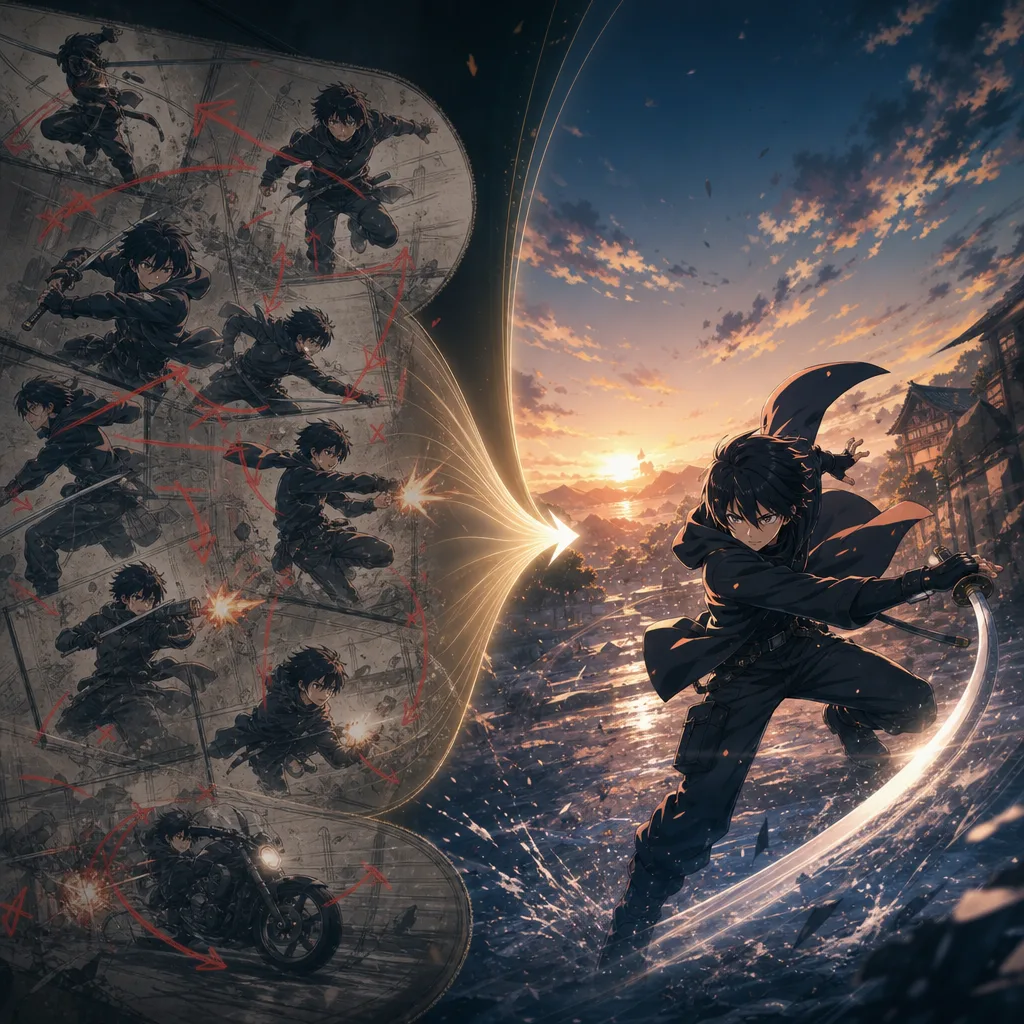
This is where storyboard thinking matters. Multi-action ambition belongs at the sequence level. Single-action clarity belongs at the shot level.
Example Prompt 1: Rewrite an Overloaded Dance Clip
Create a 7-second 2D anime dance clip in a night street performance setting. Original dancer: short pink hair, black cropped jacket, teal skirt, white sneakers, and a silver star necklace. Main action: she performs one clean half-turn spin and lands facing the camera in a sharp final pose with one hand raised. Supporting motion 1: her jacket hem and skirt follow the spin in a clear circular arc. Supporting motion 2: neon floor reflections pulse once under her sneakers. Camera: locked full-body front shot, no orbit, keep head to feet visible. Clean cel shading, crisp key poses, music-video lighting. Preserve hairstyle, jacket, skirt, sneakers, and necklace. No extra dancers, no jump, no costume change, no cropped feet, no text, no logo.
The clip is still lively, but it is about one spin. That is why it can work.
Example Prompt 2: Rewrite an Overloaded Fight Shot
Generate a 6-second 2D anime action shot in a ruined station at sunrise. Original swordswoman: long black ponytail, red scarf, navy coat, white gloves, and a simple katana. Main action: she draws the katana from its sheath and blocks one incoming shadow blade in front of her face. Supporting motion 1: the red scarf snaps sideways from the impact wind. Supporting motion 2: dust lifts from cracked tiles at her feet. Camera: low three-quarter medium shot, slight push-in only during the draw, impact frame at the block, then stable final pose. Keep her face, scarf, coat, gloves, and katana consistent. No multiple enemies, no jumping, no transformation, no camera spin, no gore, no text.
This prompt turns a battle into one readable impact beat.
Example Prompt 3: Rewrite an Emotional Scene
Create an 8-second 2D anime emotional shot at a quiet rainy bus stop. Original student: chestnut bob haircut, round glasses, beige cardigan, navy school bag. Main action: she lowers her umbrella slightly and takes one small step closer to the unseen listener. Supporting motion 1: rain drips from the umbrella rim into puddles. Supporting motion 2: her fingers tighten once on the school bag strap. Camera: medium close-up from the front with a slow push-in, no cuts, no dramatic zoom. Soft streetlight, wet asphalt reflections, restrained acting. Preserve glasses, cardigan, bag, and hairstyle. No subtitles, no crying burst, no hug, no extra characters, no text, no logo.
The shot works because the emotion is carried by one visible action, not a whole speech.
Common Mistakes
The biggest mistake is treating action words as free. Every action consumes timing, body control, and attention. A short clip has a small budget for movement.
Another mistake is using camera motion to hide weak action. If the pose is not clear, camera shake usually makes it worse.
Creators also combine emotional beats that fight each other. A character cannot convincingly be shocked, laughing, crying, attacking, and relaxing in six seconds.
A fourth mistake is adding extra characters too soon. Multiple bodies multiply drift risk. Start with one character unless the shot requires interaction.
Finally, do not fix every failure with negative prompts. Reduce the action load first, then add constraints.
FAQ
How many actions can a short AI video prompt contain?
For 5-8 seconds, use one primary action and up to two supporting motions. Longer sequences should be split into separate shots.
Is camera movement bad for AI anime video?
No. Camera movement is useful when it clarifies the action. Problems start when the camera has its own dramatic arc while the subject is already moving heavily.
How do I make action feel bigger without adding more actions?
Use stronger anticipation, a clearer final pose, lighting changes, fabric motion, impact frames, dust, sparks, or sound design notes. Scale can come from emphasis, not extra events.