

Introduction: The World Resets When the Rules Stay Invisible
The first clip looks promising: a courier steps through a floating gate, the city has a strange color system, and the costume hints at some larger society. Then the next clip treats the gate like a random portal, the costume loses its symbol, and the city no longer behaves the same way. The world did not fail because it lacked lore. It failed because the rule was never made visible enough to survive another shot.
Series worldbuilding for AI anime needs more than place names and mythology. It needs repeatable production rules: what exists, where it appears, what it costs, who is allowed to use it, what symbol reveals it, and what exception creates drama. Character-world coupling adds one more requirement: the character design should prove the world. A tool, uniform seam, charm, scar, work habit, or forbidden color should tell the viewer how the setting works.
Use this framework when your worlds reset between clips, when characters look pasted onto locations, or when each new prompt invents new rules. Open 2D Animation AI Templates for shot structures and keep Character Sheet Templates nearby for identity anchors. Then build the shared world in ArcLoop Worlds before generating a long sequence.
Core Principles for Series Worldbuilding and Character Coupling
Start with a rule the camera can show. "Dreams are currency" is a premise. "Every purchase leaves a pale stamp on the buyer's wrist until the dream is repaid" is a visible world rule. The second version can appear in character design, props, and close-ups.
Attach the rule to a place. A world rule feels abstract until it changes a street, classroom, train car, shop counter, shrine gate, repair dock, or bedroom. Decide where the audience first sees the rule working.
Give the rule a cost. If magic, technology, status, or travel is free, scenes lose tension. The cost can be time, memory, voice, battery, social rank, color, sleep, weather debt, or physical damage. The cost should create choices in later episodes.
Choose one recurring symbol. A knot, stamp, lantern color, missing button, cracked tile, bell tone, gate mark, or glove pattern can remind viewers that the same world is still operating. Keep it simple enough to survive animation.
Make character design carry the world. Clothing, tools, habits, and marks should not be random flavor. If a character repairs wind bridges, their gloves, bag, posture, and prop wear should show that job. If someone belongs to a memory market, their accessories should reveal what they trade or owe.
Define an exception early. Exceptions are where stories begin: the gate opens for the wrong person, a debt mark disappears, a banned color returns, or a tool works outside its district. A series needs a rule, but it also needs a meaningful break in the rule.
Step-by-Step Series Worldbuilding Prompt Method
Write the world rule in one sentence. Use plain cause and effect: "In this city, each bridge opens only when a resident gives up one remembered sound." If the rule cannot be filmed, rewrite it until it produces an object, gesture, mark, or visible consequence.
List fixed and flexible elements. Fixed elements include rule, place logic, cost, recurring symbol, character-world anchor, and forbidden contradiction. Flexible elements include time of day, location dressing, minor props, weather, and episode-specific conflict.
Couple each main character to the world. For every important character, write one sentence that explains how their design proves the setting: a rain scribe carries waterproof ink scars, a gate mechanic wears numbered hinge charms, a memory baker keeps blank recipe cards tied to her sleeves.
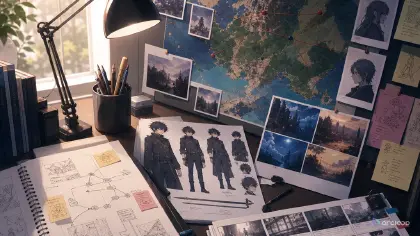
Turn the rule into a world board: write it into the Story Outline as one compact passage covering rule, place, cost, symbol, exception, character anchors, and three shot ideas. Keep it visual and reviewable — a passage you can scan, not a wall of lore that cannot guide a single frame.
Generate a small continuity test. Make one establishing shot, one character close-up, and one action or decision shot. If the rule, cost, symbol, and character anchor survive all three, the world is ready for episode planning.
Revise only the weak layer. If the symbol is clear but the cost is invisible, change the scene action. If the character looks detached from the world, repair clothing, tool, habit, or mark. If the location contradicts the rule, repair the scene concept before polishing.
Where the World Rule Lives: Story Outline and Scene Assets
Keep the world rule as a working part of the project, not a document sitting outside the generation flow. Write the rule, cost, symbol, exception, and location logic into the Story Outline, and build any location that recurs across episodes as a Scene asset in My Assets. Keep the cast's character assets next to it, so the design anchors are visible every time you build a new storyboard or write a shot description.
For storyboards, use Hook to Reveal Storyboard when you need to introduce a rule through a small reveal, or Three-Shot Continuity Board when you need to test whether the same world logic survives across cuts.
Review in this order: rule, coupling, continuity, clarity, polish. Rule asks whether the scene shows how the world works. Coupling asks whether the character design belongs to that rule. Continuity asks whether the next shot still agrees. Clarity asks whether the viewer can understand the beat quickly. Polish comes after those checks.
The simplest useful workflow is one world card, one character sheet, three test shots, and one revision note. Add more lore only when a new episode needs it.
Example prompt 1: World Rule Board for the Bell-Bridge City
Create a character asset for Tavi Renn, an original 2D anime bridge repair apprentice in Bell-Bridge City, a mountain town where bridges unlock only when someone gives up a remembered sound. The toll costs the giver that sound from memory until it is repaid, and small brass bell knots tied to gloves and doorframes mark who has paid. Tavi is one of the rare apprentices who can still hear sounds that other people have already given away, and it shows in how carefully she moves — slate-gray hair kept short for work, yellow work gloves, a belt of silent bells at her hip, and a habit of touching the railing before she crosses. Main image: front view in full work gear against a footbridge backdrop. Reference images: close-up on the bell belt and gloves, and a three-quarter view crossing a bridge at dusk with the toll bells catching the light.
This prompt creates a world where the rule, cost, symbol, and character design all point to the same system.
Example prompt 2: Character-World Coupled Episode Shot
Generate a 7-second 2D anime shot using the approved Bell-Bridge City world card and Tavi Renn character sheet. Scene: Tavi stands on a narrow cliff bridge at sunrise after a bell toll has taken the town's morning birdsong. Character anchors: slate hair tied back with a copper pin, yellow work gloves, gray repair vest, belt of silent brass bells, careful posture. Camera: medium side view with the bridge rail in the foreground, cliff houses behind, and the repair tower in the distance. Action: Tavi touches the rail, notices one bell vibrating without sound, and chooses to cross anyway. Show the world rule through the bell knot, the missing birdsong mood, and Tavi's glove habit. Soft cel shading, cool mountain light, thin line art. No text, no random magic portal, no character redesign, no new rule, no extra fingers.
The shot does not explain lore in a caption. It lets clothing, tool, habit, place, and action show the world.
Example prompt 3: Worldbuilding Continuity Revision
Revise the selected Bell-Bridge City close-up. Approved content: Tavi Renn holds the bridge rail while a silent brass bell vibrates at sunrise. Current problem: the take looks dramatic, but the character design no longer proves the world rule because the yellow work gloves and belt of bells disappeared. Preserve the camera angle, sunrise bridge, cliff houses, quiet mood, and vibrating bell. Change only the character-world coupling layer: restore yellow work gloves, gray repair vest, belt of silent brass bells, and the habit of touching the rail before crossing. Make the cost visible through the absence of birds and the silent vibration, not through text. Keep the same thin-line 2D anime style. No new character, no fake writing, no portal, no weapon, no glossy 3D.
This revision absorbs the common failure from character-world coupling: the setting remains interesting, but the character stops carrying the rule. The fix is narrow.
Common Mistakes in Series Worldbuilding
The biggest mistake is writing lore that never appears on screen. Histories, factions, and maps can help you think, but each generated shot needs visible rule evidence: marks, costs, habits, architecture, tools, or behavior.
Another mistake is separating character design from world logic. If the costume could move to any other setting without changing, it is not doing enough work. Give the character one detail that only makes sense in this world.
Creators also introduce a new rule every time a scene feels thin. That makes the series wider but weaker. Reuse the same rule in different pressures before inventing another system.
A fourth mistake is forgetting cost. Free powers and frictionless technology produce pretty clips with no decisions. Add a cost that changes what the character chooses in the scene.
Finally, do not polish contradictions. If one shot says bridge bells store memory and the next uses them as weapons, resolve the rule before final render. Consistency is cheaper than explaining mistakes later.
FAQ
How much worldbuilding should I include in an AI anime prompt?
Include only the part that affects the shot: rule, place, cost, symbol, exception, and the character anchor tied to that rule. Keep deeper lore in the Story Outline, not in every shot description.
What is character-world coupling?
It is the practice of making character design reveal the setting. Clothing, tools, marks, posture, habits, and props should show how the world works instead of sitting on top of it as decoration.
How do I stop the world from resetting between clips?
Keep the rule, cost, symbol, and location logic in the Story Outline and the cast as character assets in My Assets, then reuse the same anchors — via @ reference — across every storyboard beat. Change the episode situation, not the operating logic.
Should I build the world or the character first?
Build the first visible rule and first character anchor together. If the world rule has no effect on the character, it may stay abstract. If the character has no tie to the world, they may look pasted into the setting.
How do I plan scripts, storyboards, and continuity for a series world?
Keep the rule and location logic in the Story Outline, the cast as character assets in My Assets, and the beats laid out on the Storyboard. Because all of it lives in the same project, planning and continuity work happens on the same path you will use to generate the final clips, instead of a separate document you have to keep syncing.