
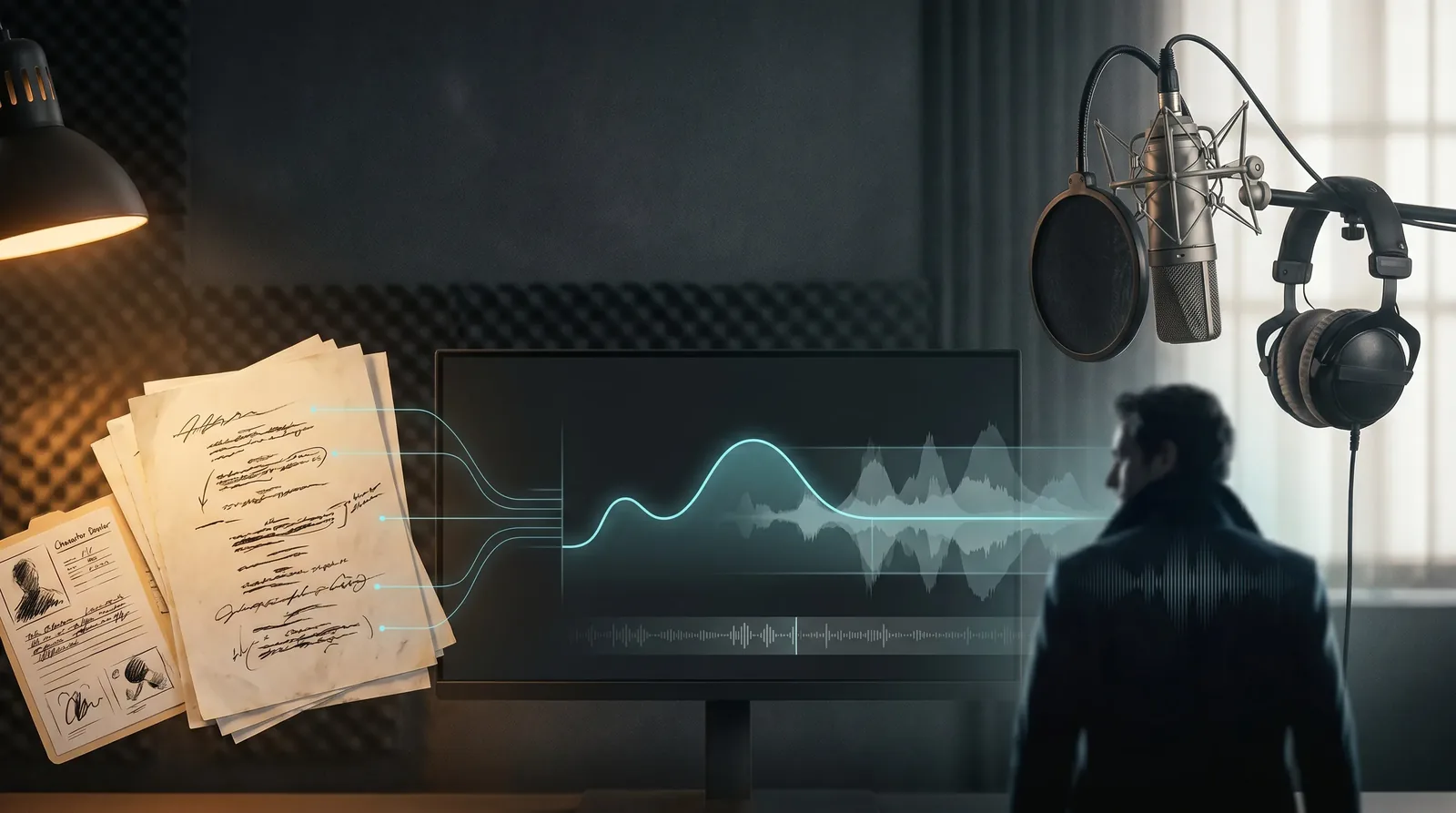
AI short-drama dubbing usually fails for a specific reason: the voice is clear, but it does not sound like a character inside a scene. The line is readable, yet the emotion is flat. It feels like narration instead of someone arguing, hiding panic, flirting, breaking down, or trying not to cry.
So the real task is not only to generate audio. The task is to make the voice fit the character, the emotional state, and the scene. One line such as "Why are you only coming back now?" can be accusation, hurt, fear, or someone forcing themselves to stay calm. The model can only hear that difference if your prompt gives it performance context.
This guide keeps the core question narrow: when should you use Seed Audio 1.0, and when should you use ElevenLabs for AI drama dubbing? The examples below compare both models through practical drama scenes, then connect the listening demos back to a reusable Arcloop workflow.
Make AI character voices sound less fake
Do not start with only the dialogue line. Before generation, define three things:
- who the character is
- what emotion and scene the line belongs to
- what the voice should feel like to the listener
Instead of writing:
Why are you only coming back now?
write:
A young female character lowers her voice, hurt and angry, as if she is trying not to lose control.
Line: Why are you only coming back now?
The prompt does not have to be long, but it has to be specific. "Sad" gives the model an average emotion. "Trying to stay quiet, but the anger breaks on the last words" gives it something to perform.
Start with the model roles
Seed Audio 1.0 is stronger when you want a performed scene, not just a clean spoken line. Give it character state, scene context, vocal texture, pacing, and emotional movement. It is useful for tense confrontations, crying scenes, dialect, atmosphere, and whole passages where the voice has to carry story pressure.
ElevenLabs is stronger when you already have a voice direction and need stable, reusable character dubbing. If a drama has recurring characters, the voice cannot change from episode to episode. ElevenLabs is useful for voice consistency, multilingual versions, fixed character voices, and line-level polishing with audio tags such as [whispers], [crying], or [angry].
This is not a ranking. It is a production split: when should the model understand the whole scene, and when should you refine a specific human voice?
When to use which one
If the scene is emotionally heavy, such as an argument, confession, breakdown, or suppressed goodbye, try Seed Audio 1.0 first. If the project depends on a stable cast voice across episodes, use ElevenLabs as the voice consistency layer and refine key lines with tags.
| Seed Audio 1.0 | ElevenLabs | |
|---|---|---|
| Best job | A full scene voice plan: character, emotion, environment, and rhythm together | Stable character voices, line polishing, multilingual dubbing, long-term reuse |
| Common scenes | Arguments, crying, collapse, dialect, narration with ambience or sound effects | Serial dramas, animated characters, AI influencers, OC characters, multi-speaker dialogue |
| Input style | Describe character, scene, voice tone, and the actual spoken text | Choose a voice first, then insert tags such as [whispers] or [crying] into the line |
| What makes it work | Write the relationship, motive, and emotional turn, not only an emotion word | Use tags only where the performance truly changes |
| Workflow position | After script breakdown, generate a listenable scene pass | After voice direction is chosen, polish important lines or alternate language versions |
In practice, you can use both. Let a character card and scene prompt create a first performed pass. Then take the most important lines into a voice-stability or tag-based pass for refinement.
Eight practical dubbing scenes
Play 1 · Confrontation: perform restraint and collapse
Confrontation scenes fail when the prompt only says "sad." Write how the character holds back, where the control breaks, and which words carry the wound.
# Seed Audio 1.0
Reference context: [#This ring belonged to my sister, didn't it?]
Voice instruction: [#Use a trembling, hoarse, almost-crying voice, forcing the collapse down; slower pace]
Synthesis text: 我找了她三年。你却把她的戒指,戴在了别人手上。
Generated from the Seed Audio instruction above. Listen for how the line holds back the breakdown before it finally leaks through.
# ElevenLabs
[whispers] I searched for her for three years…
[crying] and you put HER ring… on someone else's hand.
Generated from the ElevenLabs tag example above. Listen for the whisper, crying tone, and emphasis on the key wound.
Play 2 · Flirting, intimacy, and ASMR whisper
Intimate drama audio is not only quieter. It needs distance, breath, pauses, and a tail tone that feels close to the listener.
# Seed Audio 1.0
Voice instruction: [#Use an ASMR-like whisper, soft and slightly coaxing]
Synthesis text: 别走嘛……再陪我待五分钟,就五分钟,好不好?
Generated from the Seed Audio whisper instruction. Listen for near-field breath, light pauses, and the coaxing ending.
# ElevenLabs
[whispers] Don't go yet… [playful] just five more minutes, okay?
Generated from ElevenLabs whisper and playful tags. The point is close distance, breath, and a soft emotional tail.
Play 3 · Dialect jokes: where Seed Audio has an edge
In Chinese short drama, dialect is often part of identity and relationship, not decoration. The prompt needs the regional tone and the social attitude behind it.
# Seed Audio 1.0
Voice instruction: [#Use natural Sichuan dialect, teasing and a little proud]
Synthesis text: 你娃儿还想骗我?我啥子场面没得见过哦。
Generated from the Seed Audio dialect instruction. Listen for teasing, confidence, and relationship texture in the dialect.
Play 4 · Multiple roles: finish a short exchange in one pass
If two characters are pressuring each other, generating line by line can make the scene feel disconnected. Keep the speaker relationship and emotional contrast in one pass when possible.
# ElevenLabs
Speaker 1: [coldly] You shouldn't have come back.
Speaker 2: [shaky] I had to. [whispers] I saw the ring.
Speaker 1: [angry] Then you saw NOTHING. Get out.
Generated from the multi-speaker format above. Listen for how cold, shaky, and angry tags separate the pressure between speakers.
Play 5 · Full atmosphere: narration, ambience, and sound effects
This is where Seed Audio 1.0 differs most from ordinary TTS. You may not want only a voice. You may want a scene-ready audio draft with narration, environment, suspense, and sound effects working together.
# Seed Audio 1.0
Voice instruction: [#Late-night hospital corridor; suppressed fearful narration; add subtle footsteps and dripping water in the background]
Synthesis text: 可当他的手触碰到对方的身体时,却感觉一阵冰冷,那触感……不像是活人。
Generated from the Seed Audio scene instruction. Listen for narration, environment, and suspense serving one dramatic beat.
# ElevenLabs
[ominous] The hallway was empty… [footsteps] something was following her.
[gasp] [gunshot] — Run!
Generated from the inline sound-effect tags above. The tags turn narration into a more complete suspense passage.
Play 6 · Context continuation: make the reply actually answer
When every line is generated in isolation, characters can sound like they are not listening to each other. Feed the previous line and the relationship state so the next line can answer the moment.
# Seed Audio 1.0
Reference context: [#Is... is it you? You look like you haven't changed much.]
Voice instruction: [#A reunion after many years; surprised, warm, slightly choked up]
Synthesis text: 你头发长了……以前总说留不长。十年了,你还好吗?
Generated from the reference-context instruction above. Listen for how the reply carries reunion, warmth, and a slight choke in the voice.
Play 7 · Voice cloning: give the character one voice across episodes
A drama voice is not only a demo. If the lead appears for many episodes, the audience has to recognize the same person every time. Treat voice cloning, reference audio, voice settings, and the character card as production assets. Only clone voices you own, have permission to use, or are explicitly provided by the platform.
Play 8 · Character card: the flagship way to direct performance
The first seven plays are techniques. A character card turns them into a repeatable asset. It tells the model who the character is, where the scene is happening, what the voice should feel like, and what the spoken text is.
The audio below was generated from the Chinese character card used in the source demo. It is kept in Chinese so the text matches the attached listening sample.
【角色设定】
沈砚——表面清冷自持的世家公子,惯把脆弱藏在礼数与锋利言辞之下,从不在人前低头。
久病缠身,今夜是他自知撑不久的一晚。正因为他一向骄傲、克制,此刻的卸防与示弱才格外
动人:他不是天生温柔,是为了你,才肯软下来。

【场景】
深夜,烛火将尽的卧房,窗外初雪。他半靠床头,把伏在膝边啜泣的你轻轻拉进怀里。
声音很轻——说话已经耗力,越想温柔,气息越散。

【音色】
成年男性,低沉沙哑、气声偏多的磁性嗓音,近场耳语距离。语速缓慢、停顿长、呼吸清晰可闻。
基调:疲惫、隐忍、不舍,间或一丝他惯有的、被你看穿的轻佻笑意;尾音发颤,是极力克制
不让自己碎掉。魅惑来自压低的胸腔共鸣与气声,而非用力——越脆弱,越要轻。
This audio comes from the character-card sample above. It shows how a role, scene, voice tone, and line context can turn dialogue into a performed arc.
How to feed this to the models:
- Seed Audio 1.0: treat character, scene, and voice tone as director instructions; keep the actual spoken text separate. Convert action notes into voice instructions so they are not read as dialogue.
- ElevenLabs: choose the closest voice first, then translate performance notes into inline tags such as
[weakly],[whispers],[voice trembling], or[chuckles softly]. Split long passages by emotional beat.
A simple prompt template
Young male character, low voice, exhausted, as if he has just finished an argument.
Slow pace, suppressed emotion.
Line: I don't know how to trust you anymore.
Generate once, then listen in order: first for emotion, then for character fit. If the voice is too flat, strengthen the emotional path. If it is too theatrical, reduce the intensity. Do not judge only in isolation; put the voice back against the shot, face, action, and edit rhythm.
A simple AI drama dubbing workflow
- Prepare the character line. Do not only paste dialogue. Add the current emotion, scene, and relationship context. For upstream script work, see DeepSeek V4 for AI drama script breakdown.
- Choose the audio model. Use Seed Audio 1.0 when emotional performance matters most. Use ElevenLabs when stable character voice and reuse matter most. For recurring roles, define voice anchors in an AI character bible.
- Write the voice prompt. Keep it concrete: who is speaking, how close the voice is, whether the emotion is hidden or breaking, and what the exact line is.
- Generate and review. Listen for emotion first, then voice fit. Save useful character cards, voice choices, settings, and failed attempts.
- Test inside the scene. The voice has to work with the shot, expression, action, and story beat. For the visual side of the same asset chain, see GPT Image 2 for consistent drama visuals.
In one sentence: the script gives the emotion, the character bible gives the voice identity, and Seed Audio 1.0 or ElevenLabs renders those rules into sound. Start in Arcloop Worlds when you are ready to keep scripts, characters, and voices in one production context.
FAQ
Which model should beginners try first? For Chinese short drama, emotional scenes, dialect, or atmosphere-heavy passages, start with Seed Audio 1.0. For recurring voices, multilingual work, and line-level polishing, try ElevenLabs. The most practical test is to generate both from the same scene.
How is Seed Audio 1.0 different from ordinary TTS? Ordinary TTS produces a spoken voice. Seed Audio 1.0 is better treated as a scene-audio generator: character, emotion, narration, environment, and sound effects can serve one dramatic goal.
Can ElevenLabs work for Chinese drama? Yes, but test it with real Chinese lines and character usage. Its strengths are voice libraries, stability, multilingual workflows, and tags; dialect and local web-drama phrasing should be checked case by case.
How do I keep a role from sounding like a different person? Treat the voice as an asset: keep the same voice or clone, the same settings, and the same character card. Changing voice, settings, or the card can make the role feel recast.
Why are some examples in Chinese? The listening set was created for a Chinese short-drama dubbing workflow, so several Seed Audio examples keep the original Chinese text to match the audio. The workflow applies to other languages: define role, emotion, scene, voice tone, and reuse rules before generation.