Introduction
A sword trainee lands from a jump with both feet perfectly even, both arms raised at the same angle, cape spread like a symbol, and face frozen straight ahead. The image may look clean. In motion, it feels artificial. Viewers may not use the phrase "motion symmetry," but they can tell the body is not carrying weight.
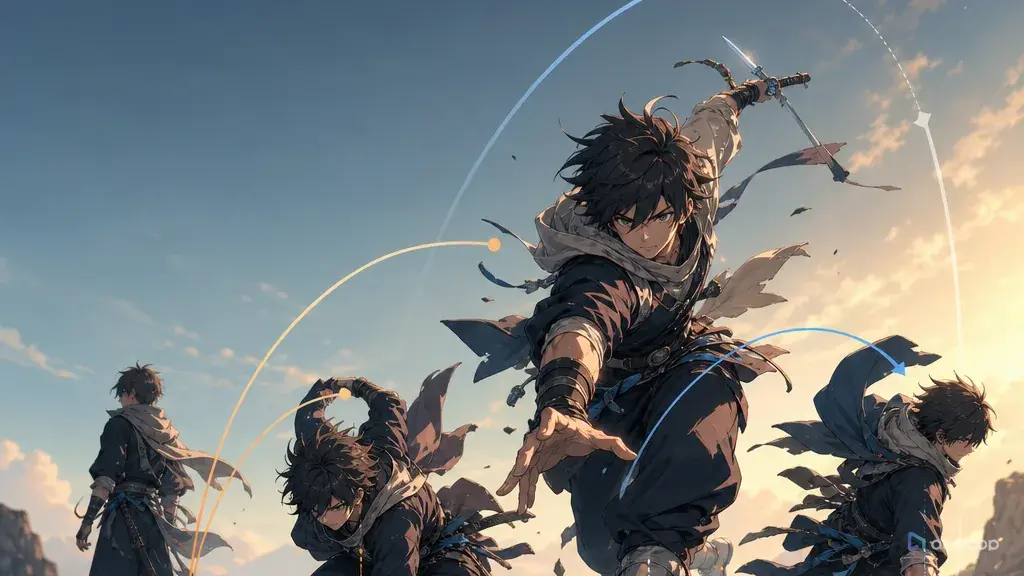
That is the common hidden failure in AI anime action. The creator sees a dramatic pose. The audience sees a body that glides, mirrors itself, or moves like a figure being posed one limb at a time. Real action is rarely perfectly balanced. One foot lands first. One shoulder leads. One hand reacts late. The torso twists. The face catches up after the body.
Motion asymmetry is the practice of adding those offsets deliberately. It does not mean making the character messy. It means choosing a lead side, support side, weight shift, arc, follow-through, and recovery beat. Anime often exaggerates action, but the exaggeration still works because the body has direction.
This guide explains how to prompt natural action with motion asymmetry. It is useful for runs, turns, reaches, strikes, falls, dance moves, reactions, and everyday gestures. For adjacent topics, see Fix Stiff Action, Action Verb List for AI Anime Prompts, and Creative Worlds for keeping action notes attached to shots.
Core Principles
Natural motion has a lead. A right hand reaches before the shoulder follows. A left foot plants before the body turns. A head turns after a sound, then the torso catches up. Name the lead side.
Weight must go somewhere. If a character leans, lands, pivots, or pushes, the prompt should say which foot, hand, hip, or surface takes weight. Without weight, action floats.
Symmetry is useful only for symbols, rituals, and held poses. A ceremonial stance may be centered. A sprint, dodge, stumble, grab, slap, or surprised turn should not be perfectly mirrored.
Timing offsets create life. Let the coat lag behind the torso, the hair continue after the head stops, or the free hand react half a beat late. These small delays make motion readable.
Contact points prove physics. A palm on the wall, boot on the step, knee bending under impact, or fingers gripping fabric tells the viewer the character is interacting with the world.
Recovery is part of the action. A punch is not only the fist moving forward. It includes the stance before, the contact line, and the body returning or overbalancing after.
Do not add five actions to fix one stiff action. A clear asymmetric reach is stronger than a prompt that asks for reach, turn, jump, smile, grab, and spin in the same shot.
Step-by-Step Motion Asymmetry Method
Start with one verb. Use "reach," "pivot," "stumble," "land," "duck," "pull," "brace," "turn," or "step back." Avoid stacking verbs until the first action is clear.
Choose the lead side. Decide whether the right hand, left foot, shoulder, hip, head, or prop starts the movement. Write it plainly: "left foot plants first" or "right shoulder leads the turn."
Add the support side. The support side balances or resists the lead. If the right hand grabs a railing, the left foot may slide back. If the left foot plants, the right arm may swing behind for counterbalance.
Name the weight shift. Say where the body weight begins and where it ends. "Weight shifts from back foot to bent front foot" is more useful than "dynamic pose."
Define the action arc. Movement usually travels along an arc, diagonal, or curve. Give the motion a path: downward-right, forward-left, clockwise turn, low arc across the body, or rising diagonal.
Add one secondary delay. Choose hair, coat, scarf, sleeve, loose strap, or free hand. Let it lag or follow through. One delay is enough.
Set the final recovery pose. The last frame should be editable: foot planted, hand gripping, body angled, eyes on target. Without a final pose, the shot may end in mushy transition.
Review the body silhouette. Mute details and ask whether you can still tell which side leads, where weight sits, and what contact point matters.
Where Action Notes Live: On the Shot Card
In ArcLoop, action notes should sit on the shot card as production facts. Put lead side, support side, weight shift, contact point, timing offset, and final pose beside the camera and character reference. That keeps the motion from becoming a generic "dynamic action" prompt.
Use Creative Worlds to store the action plan with the character sheet and shot list. If the character identity is already built in Character Sheet References, do not rewrite the whole character when fixing motion. Add the action layer to the approved character.
For review, use a small pass-fail list: lead side visible, support side believable, weight grounded, contact point clear, secondary motion delayed, final pose readable, no mirrored limbs unless intentional. This catches most stiff-action problems without a complex system.
If a generated clip has a strong face and costume but mirrored motion, repair only the motion. Ask for the same character, same camera, same scene, with a corrected lead side and weight shift. Full restarts are for shots where the body cannot be salvaged.
Example prompt 1: Rooftop Antenna Pivot
Create an 8-second AI anime action shot with natural motion asymmetry.

Original character:
Soren, rooftop signal runner, cropped silver hair, orange utility sash, dark sleeveless jacket, taped left wrist.

Scene:
Windy apartment rooftop at blue hour. A bent antenna pole stands behind him. Loose paper tags whip in the wind.

Action:
Soren hears a signal behind his right shoulder and pivots to turn around.

Motion asymmetry:
Right shoulder reacts first. Left foot plants hard near the roof seam and takes weight. Right foot slides a half-step back. Left hand opens for balance while the taped right wrist moves toward the orange sash. Head turns first, torso follows half a beat later, jacket hem lags behind the twist. Final pose: body angled three-quarter back, left foot planted, eyes looking over right shoulder toward the antenna.

Camera:
Medium full-body shot, slight low angle, stable camera, no spinning camera.

Negative constraints:
No perfectly mirrored arms, no both feet landing together, no floating body, no front-facing final pose, no random jump.
This prompt turns a simple pivot into a body event. The viewer can see where the turn starts and where the weight lands.
Example prompt 2: Archive Ladder Reach
Write a natural-action AI anime prompt for a library reach.

Original character:
Junel, apprentice archive climber, chestnut ponytail, navy apron dress, cream sleeves, small brass index tags.

Scene:
Tall circular archive with rolling ladders and warm shelf lights. A glowing index card is stuck above the third shelf.

Action:
Junel reaches from a rolling ladder to grab the glowing card.

Motion notes:
Left hand grips the ladder rail and takes support. Right arm reaches upward-left toward the card. Weight stays on the bent right foot on the ladder step. Left foot hovers slightly lower, searching for balance. Torso leans diagonally, ponytail and apron ribbon lag downward from gravity. Fingers stretch first, then shoulder follows. Final frame: right fingertips touching the card, left hand still gripping rail, body clearly off-center but balanced.

Review requirement:
The action must not become a centered T-pose, two-handed reach, floating body, or symmetrical ladder pose. Keep one support hand and one reaching hand.
The ladder makes asymmetry necessary. One side acts, one side keeps the character alive.
Example prompt 3: Market Stall Stumble
Create a motion-asymmetry review and repair prompt for a 6-second AI anime stumble.

Original character:
Pella, night market food courier, short black curls, yellow delivery vest, red wrist cord, carrying a paper soup tray.

Approved action:
Pella slips on a wet tile while turning left around a stall. Her right foot skids forward. Her left knee bends to catch weight. Her right hand lifts the soup tray high to save it. Her left hand shoots out toward the stall cloth for balance. The red wrist cord stays on the left wrist. Final pose: left hand gripping stall cloth, soup tray still upright, body tilted left, eyes wide toward the tray.

Task:
Review a generated clip for natural asymmetry. Reject if both arms lift equally, both feet slide together, the tray floats, the wrist cord switches sides, or the body remains perfectly vertical. Provide the smallest repair prompt that keeps character, costume, market setting, and soup tray but fixes lead foot, support hand, weight shift, and final pose.
This review prompt protects the comedy beat. The stumble is funny because the body is uneven while the tray stays upright.
Common Mistakes
The first mistake is using "dynamic" as a substitute for body mechanics. Dynamic can mean almost anything. Lead foot, support hand, and final pose mean something.
Another mistake is making every action centered. Centered poses can look iconic, but repeated centered motion makes running, dodging, and reaching feel weightless.
Creators often forget contact. A hand near a wall is not the same as a hand pressing into a wall. A boot above the floor is not a planted foot.
A fourth mistake is asking for too much action in one short clip. If the character jumps, spins, grabs, smiles, dodges, and lands, the model may average the movement into a stiff pose.
Some prompts add secondary motion everywhere. Hair, coat, ribbons, dust, and background all moving at once can hide the body action. Pick one or two follow-through elements.
Finally, do not polish a pose before the silhouette works. If the body cannot be read in simple shape, extra detail only decorates the problem.
FAQ
What is motion asymmetry?
Motion asymmetry means the body does not move as a mirrored shape. One side leads, another supports, weight shifts, and small details lag or recover.
Does anime action need realistic physics?
It needs readable physics, not documentary realism. Exaggeration works when the viewer can still understand weight, direction, contact, and recovery.
How do I make a run look less stiff?
Name the lead foot, arm swing, torso lean, head direction, and final frame. Avoid asking both arms and both legs to mirror each other.
What should I review in an action clip?
Check lead side, support side, weight, contact point, action arc, follow-through, and final recovery pose.
How do I fix the action without touching the character?
Yes. Keep the approved character sheet and scene, then repair only the action fields on the shot card: lead side, weight shift, contact point, timing offset, and final pose.